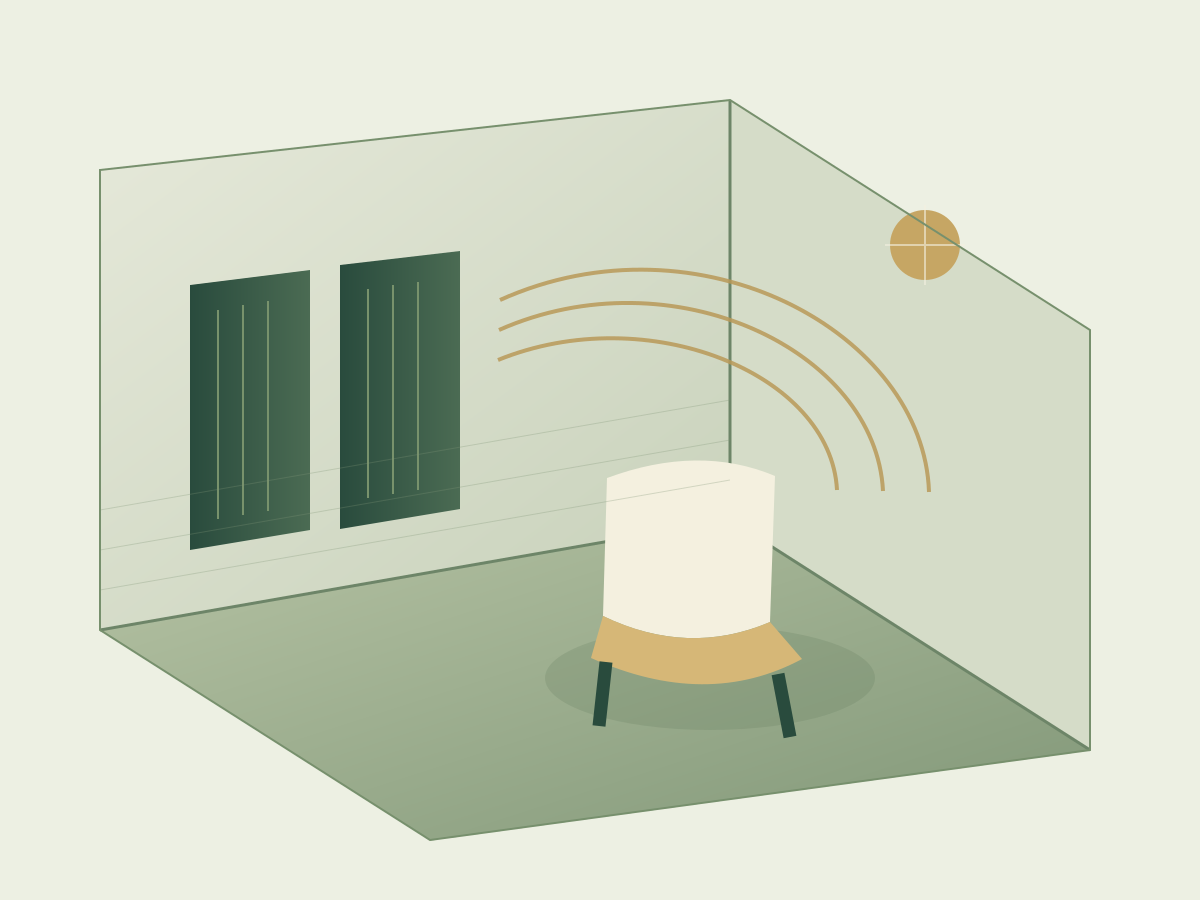
Absorption: what returns to the room.
When sound meets a surface, some energy can be reflected, some absorbed and some transmitted. Absorption concerns energy taken up by the material. Treatment is often used to change reflections and reverberation within a room.
Source: Rockfon’s acoustics explanations, read as manufacturer technical guidance.
Isolation: what reaches another space.
Sound isolation concerns transmission between spaces. Performance depends on the construction as a whole, including its connections, rather than the appearance of one surface panel. A decorative absorber should not be treated as a guarantee that neighbours will no longer hear music.
Describe where the unwanted sound starts and where it is heard. A photograph of the room can document the question, but it cannot identify every transmission path.
Ask what the number describes.
Keep the test with the claim.
An absorption rating and a sound-isolation rating answer different questions. Ask for the exact product, test method, installation arrangement and frequency-dependent results behind a claim. Do not compare two headline numbers as if they measured the same thing.
A laboratory result is not a prediction for your particular room. Keep the maker’s report, the proposed configuration and the installer’s requirements together.
Choose a path that fits the problem.
- Lingering sound inside the room: start with a repeatable listening observation, then investigate treatment.
- Sound between rooms or from outdoors: seek a building-specific isolation assessment before ordering panels.
- A product says “soundproof”: ask what measured transmission result supports that word, for which complete assembly.
This distinction is a first filter, not a construction design. Do not modify partitions, doors, ventilation or fire-rated assemblies using this guide.
Sources, editorial method & limits
Reviewed 2 November 2026. The checklists and selection questions are original editorial aids, not validated tests or a professional specification. The linked manufacturer sources establish their own descriptions; no hands-on product comparison, acoustic survey or conversion-performance evidence was obtained.