
Begin with three pieces.
For a first observation, use three clean paper scraps you already own: two surroundings and one smaller color to move between them. Try the paper-and-material study before buying a specialist set.
Then name the missing capability. Do you need a wider range of similar colors, larger uncut sheets, or a surface that accepts your chosen drawing medium? Those are different purchases.
If a class supplied a materials list: match its required set and sheet size first. A smaller set can contain every named color yet still be too small for the assigned composition. Ask before substituting.
220 or 314 is only half the choice.
Color-aid’s manufacturer describes two matte-finish systems. The Standard Set contains 220 colors. The Full Set contains 314, including a larger pastel range. More colors create more choices; they do not automatically improve an observation.
220 colors
The maker supplies an organizing leaflet and grid. Color designations are not printed on the backs of this set, so keep your own labels with cut pieces.
Consider when: your materials list specifies 220, or its range covers a study you have already planned.
314 colors
The maker’s instruction booklet says the sheets carry reverse-side identifiers except black and white. Its category page lists 114 pastels versus 36 in the Standard Set.
Consider when: you need that broader range or want named colors to be easier to record and revisit.
Sources: Color-aid Standard Set, Full Set and the maker’s 2006 instruction booklet. The booklet’s date is retained; this is not a newly tested specification.
Plan the cuts before choosing the box.
A 2 × 3-inch sheet has 6 square inches of material. A 4½ × 6-inch sheet has 27: 4½ times as much area per sheet. That changes the size of backgrounds you can make and how many trials a color may support. It does not mean either format lasts 4½ times as long.
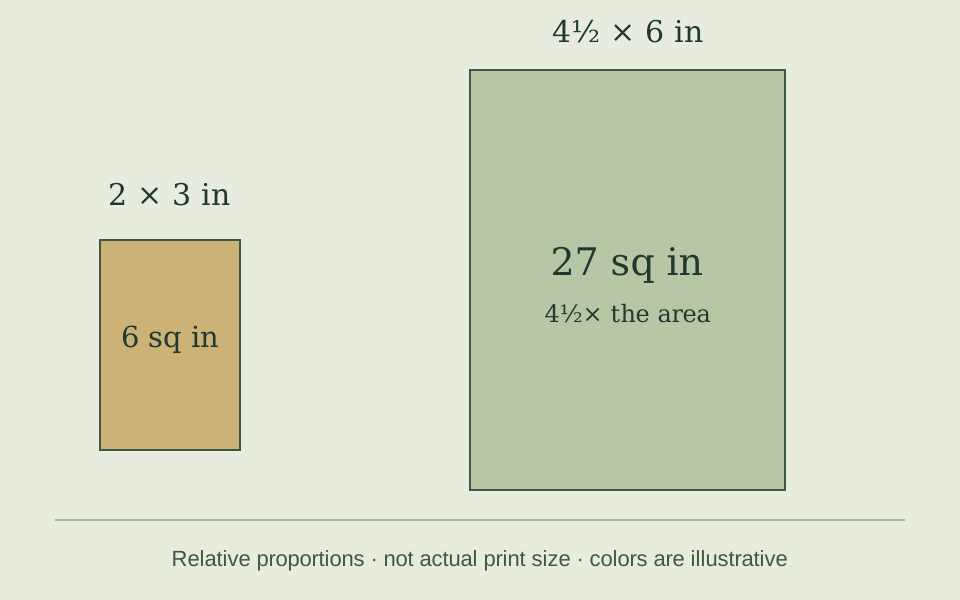
- Draw the largest background your study needs on scrap paper.
- Check that both its width and height fit the proposed sheet, allowing for trimming and mistakes.
- Decide whether you need repeated pieces of the same color. A larger color count does not promise duplicate sheets of the color you use most.
A 2 × 3-inch format can be useful for compact comparisons. Rule it out if your planned background cannot fit. Cut-paper composition and small swatch comparison are not interchangeable tasks.
Three precise formats to check.
No commission from these paper links. Awoken has no accepted affiliate relationship for the Color-aid or Blick links below and has not hands-on tested these products. These are source-based options, not a best-product ranking.
Displayed US prices checked 3 November 2026. These are item-price snapshots in USD, excluding shipping and tax. Sale prices may change. A listed product is not an availability or delivery promise.
314 colors · 2 × 3 inches
Maker F23: $36.00 displayed sale price. Blick 10528-1040: $42.23 displayed price.
For a compact color comparison when the physical pieces fit your plan. The smaller sheet is the trade-off, even though this set has more colors than the Standard system.
Both destinations are ordinary, non-commission links.
220 colors · 4½ × 6 inches
Maker S456: $66.40 displayed sale price. Blick 10528-1030: $76.94 displayed price.
For a planned composition that needs more room per color and does not require the Full Set’s range. Keep labels with your pieces because this system does not print color identifiers on their backs.
Both destinations are ordinary, non-commission links.
314 colors · 4½ × 6 inches
Maker F456: $88.00 displayed sale price.
For a study that needs both the broader color range and larger pieces. If neither requirement appears in your plan, there is no reason here to move up to this format.
This is an ordinary, non-commission maker link.
Check maker F456 >Compare the final delivered totals, not just the displayed item prices. The maker’s shipping text differs between its category and Standard item pages; resolve the actual rate in checkout. Returns, delivery dates and destination-specific availability were not verified for this guide.
Need a drawing surface instead?
Canson’s US Colorline page describes pulp-dyed paper in 150 and 300 gsm, with one smooth face and one grained face. The maker associates the smooth face with felt-tip and marker work and the grained face with pencil, charcoal and pastel.
That is a different selection question from buying a broad Color-aid comparison set. Check the exact weight, size, color and your medium on a scrap first. Do not infer wet-media or printer compatibility from a general paper description.
This is a non-commission manufacturer reference, not an exact stocked offer or a hands-on recommendation.
Read Canson’s Colorline specifications >Leave the next session a clear starting point.
- Record the maker, system, sheet size and color identifier when available.
- Keep offcuts with their labels and note which side you used.
- Record the light, surrounding paper and mark-making medium so you can repeat your own observation.
- Use the maker’s care instructions. Do not assume a screen photograph is an exact color reference or that a storage method prevents fading.
For a guided reading route, compare Interaction of Color in print, on screen, or through a library. That page clearly identifies the optional Bookshop commission link alongside non-commission and no-purchase alternatives.
Sources and limits.
What this comparison establishes
Manufacturer and retailer pages were checked on 3 November 2026. The paper format descriptions and price snapshots are attributed to those sources. The size calculation is ordinary rectangle arithmetic. The fit checklist and diagram are original editorial aids.
Awoken has not bought, handled, measured or durability-tested these packs for this guide. There is no claim of exact digital color matching, learning outcomes, product superiority, affiliate approval for paper suppliers or measured conversion improvement.
All reading works without analytics consent. This page has no worksheet submission or new data-entry field. Optional product-reference clicks, if you opt in, are clicks rather than evidence of purchases.
Read the evidence and privacy standards >